
Agent Systems Architecture: The Missing Discipline of the AI Era

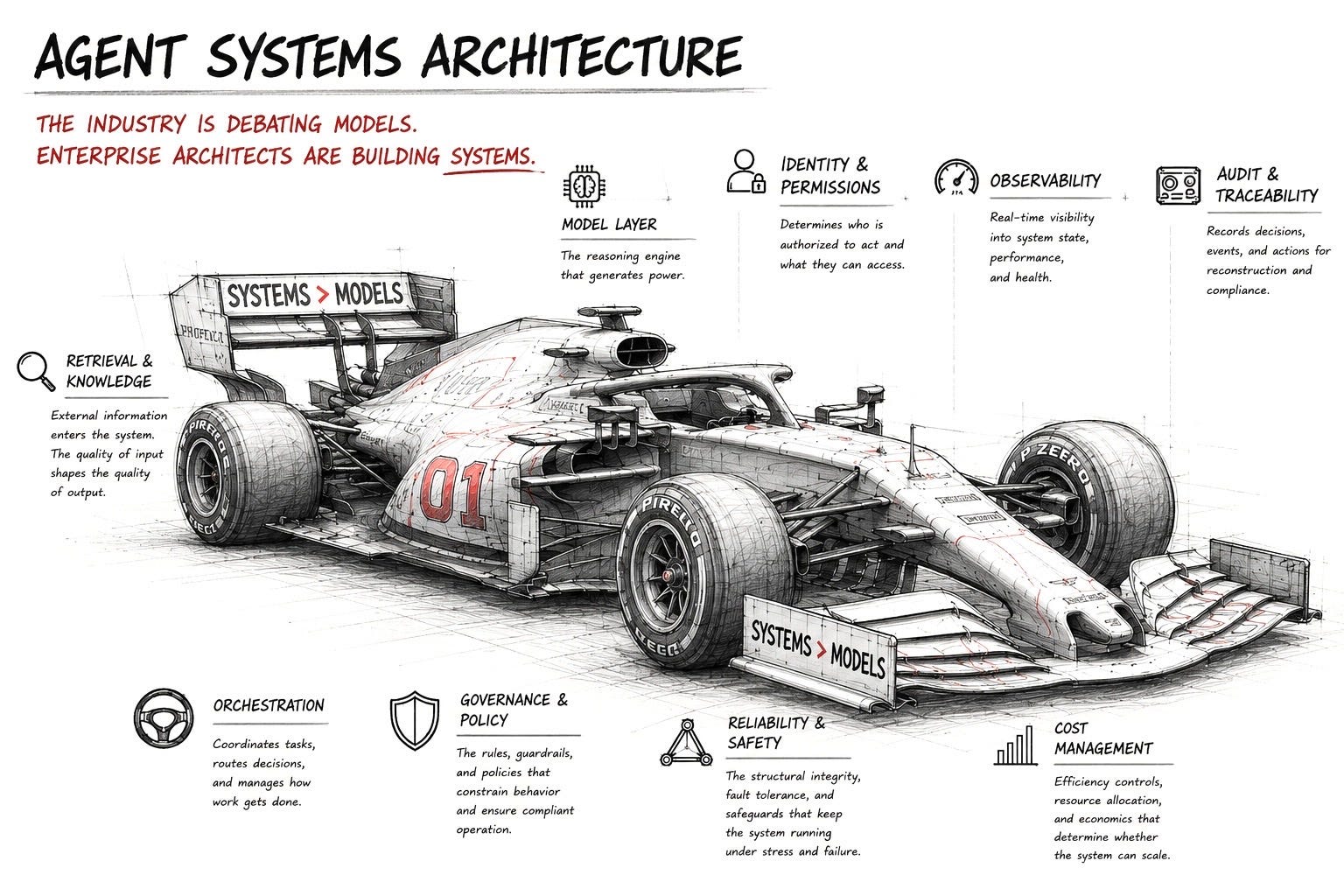
Every few days, a new post appears explaining the latest breakthrough in agent design. The labels change, but the pattern is becoming familiar.
Store skills in folders.
Compress memory.
Route requests to specialized agents.
Use context engineering.
Build multi-agent workflows.
Create tool libraries.
Use model routing.
Most of the advice is useful. Some of it is genuinely important. What is striking, however, is how familiar much of it feels. Viewed individually, these techniques look like innovations unique to the age of AI. Viewed collectively, they look suspiciously like concepts that software architects, operating system designers, database engineers, and distributed systems practitioners have worked with for decades.
Caching.
State management.
Dependency injection.
Workflow orchestration.
Access control.
Memory hierarchies.
Observability.
Reliability engineering.
The AI industry is not simply building smarter models. It is rediscovering large portions of computer science and enterprise architecture through the lens of language models.
For the past few years, the industry has largely treated models as the center of the story. Every major discussion eventually returns to the same questions. Which model is best? Which benchmark matters? Which provider is ahead? Which context window is larger? Which reasoning model performs better?
Those questions are reasonable.
They are also becoming less important than many people think.
The next phase of enterprise AI will not be defined primarily by model selection. It will be defined by architecture.
The Engine and the Vehicle
Technology industries have a habit of becoming fascinated with the most visible layer of a system.
In the early days of databases, conversations revolved around database engines. During the first wave of cloud adoption, infrastructure became the center of attention. During the rise of distributed computing, organizations debated technologies, frameworks, and protocols.
Over time, something predictable happened. The discussion moved up the stack.
Organizations discovered that selecting a component was not the same thing as building a system. The organizations that created durable advantages were rarely distinguished by a single technology choice. They were distinguished by how effectively they assembled technologies into coherent operating models.
AI is beginning to follow the same path.
Today, a great deal of attention is focused on models because they are visible. Models produce outputs. Models appear in demos. Models top leaderboards. Models are easy to compare.
Architecture is different. Architecture reveals itself slowly.
No executive walks into a board meeting excited about memory hierarchies. No investor tweets enthusiastically about observability frameworks. Nobody creates a viral benchmark comparing governance models.
Yet when organizations move beyond demonstrations and begin embedding AI into real workflows, those become the questions that determine success.
The model may be the engine.
The architecture determines whether the vehicle finishes the race.
The Shift From Intelligence to Systems
One reason this transition feels unfamiliar is that many organizations still think they are deploying AI models.
In reality, they are beginning to deploy decision systems.
A model generates intelligence.
A decision system converts intelligence into action.
Generating intelligence is a remarkable technical achievement. Converting intelligence into reliable business outcomes is an architectural challenge.
Suppose an AI agent is responsible for helping a financial institution process customer requests. The model itself may be capable of understanding the request, reasoning through alternatives, and generating a response. That is only a small portion of what must happen.
The system must determine which information sources are authoritative. It must understand the customer’s permissions. It must retrieve relevant information. It must evaluate applicable policies. It must determine which actions are allowed. It must record decisions for compliance purposes. It must operate within defined risk tolerances. It must remain cost effective. It must recover gracefully when something fails.
None of those responsibilities belong to the model.
They belong to the architecture.
The deeper enterprises move into AI adoption, the more obvious this becomes. The real question is not whether a model can reason. It is whether the organization has designed a system that can use that reasoning safely, economically, and repeatedly.
Context Is Becoming the New Memory Hierarchy
One of the clearest examples of architectural thinking can be seen in the industry’s obsession with context windows.
Every increase in context size is greeted as a major breakthrough. Larger context windows undoubtedly expand what models can process, but they have also encouraged a subtle misunderstanding.
Many organizations have started treating context as though it were memory.
It is not.
Computing solved memory management problems long ago through layers. Registers serve a different purpose than cache. Cache serves a different purpose than RAM. RAM serves a different purpose than persistent storage.
Each layer exists because different information has different requirements.
Agent systems face the same challenge.
Some information is relevant only for the duration of a task. Some information should persist throughout a session. Some knowledge should survive across interactions. Some information belongs in organizational repositories that may outlive individual employees.
When every memory problem is solved by loading more information into context, costs rise, performance suffers, and complexity increases.
The emerging discipline of agent architecture is forcing organizations to think about memory in more sophisticated ways. Not all information belongs in the prompt. Not all knowledge belongs in retrieval. Not all context should persist.
Architectural decisions determine where information lives, how it moves, and when it should be forgotten.
That same discipline applies to retrieval, where many teams are discovering that the hard part is not asking the model to search better. The hard part is making enterprise knowledge searchable in the first place.
Retrieval Is Not an AI Problem
Retrieval is rarely a model problem.
It is usually a knowledge problem.
A surprising number of enterprise AI projects eventually turn into information architecture projects. Documents are duplicated. Policies conflict. Business definitions vary across departments. Critical knowledge is trapped inside shared drives and email threads. Ownership is unclear.
The model merely exposes conditions that already existed.
Organizations often expect AI to create order from informational chaos. In practice, AI tends to reveal how much chaos already exists.
The effectiveness of retrieval depends less on model sophistication than on the quality of the underlying knowledge architecture. An agent cannot retrieve information that cannot be found. It cannot establish trust in information that lacks ownership. It cannot resolve contradictions that have never been addressed.
As a result, some of the most valuable AI work occurring inside enterprises today looks surprisingly old-fashioned.
Cataloging information.
Defining ownership.
Creating standards.
Improving metadata.
Establishing governance.
The technology is new.
The underlying challenge is not.
Once agents begin acting on retrieved knowledge, the next question becomes unavoidable: who decides what they are allowed to do?
Governance Is Moving Into the Runtime
Historically, governance lived outside operational systems.
Policies existed in documents. Approvals happened through committees. Audits occurred after decisions were made.
That model becomes increasingly difficult to maintain when agents move beyond generating content and begin taking actions.
An agent capable of approving requests, updating systems, initiating workflows, or influencing business decisions cannot rely solely on governance processes that operate after the fact.
Governance must become part of execution itself.
Policies increasingly become code.
Approvals become workflow controls.
Permissions become runtime decisions.
Risk management becomes an architectural capability.
This represents a significant shift in how organizations think about governance. Instead of acting primarily as oversight functions, governance systems increasingly become operational infrastructure.
The distinction may sound technical, but it has profound implications.
Organizations are not simply deploying AI.
They are embedding organizational policy into software.
And once policy becomes software, visibility becomes non-negotiable.
Observability Becomes Trust
Every technology platform eventually reaches a point where visibility becomes essential.
Agent systems are approaching that point rapidly.
As deployments grow, organizations inevitably begin asking difficult questions.
Why did the agent make this recommendation?
Which information influenced the outcome?
What changed between yesterday and today?
Why did costs increase?
Which workflow produced the failure?
How often does this occur?
Without observability, these questions become difficult to answer.
Without answers, trust erodes.
The relationship between observability and trust is often overlooked. Leaders rarely trust systems they cannot inspect. Regulators rarely trust systems they cannot audit. Operators rarely trust systems they cannot diagnose.
Observability is not merely an operational concern.
It is one of the foundations of organizational confidence.
It is also the layer that turns AI economics from a vague budget complaint into a measurable architecture problem.
The Economics of Intelligence
The economics of AI are becoming architectural.
That is a hard lesson many organizations will learn only after their first serious deployment bill arrives.
A pilot can hide bad economics because the usage is small, the workflow is narrow, and the number of users is controlled. Production removes that protection. The same design that looked elegant in a demo can become expensive once thousands of users, workflows, documents, tools, and approval paths are involved.
Model pricing matters, but it is only one part of the cost structure. Architecture determines how often retrieval runs, how much context is loaded, which model handles which task, how many agent steps are required, when human review is triggered, how much output is regenerated, and how often the system repeats work it should have cached.
This is where many agent systems quietly become expensive.
A poorly designed workflow may call a frontier model when a smaller model would work. It may retrieve ten documents when two would do. It may pass bloated context through every step because nobody designed memory boundaries. It may use multiple agents to simulate coordination when a simple deterministic workflow would be cheaper, faster, and easier to audit.
The issue is not that tokens are expensive.
The issue is that bad architecture spends intelligence carelessly.
Cloud computing followed a similar path. Organizations initially treated cloud cost as a pricing issue. Over time, they learned that architecture determined economics more than the rate card did. AI appears headed toward the same conclusion.
The CFO conversation around AI will eventually move beyond model subscriptions and token rates. It will become a conversation about architecture, workload design, routing, reuse, controls, and accountability.
That conversation requires a vocabulary the industry has not fully developed yet.
The Architecture Handbook We Do Not Yet Have
What makes this moment interesting is that the discipline itself is still emerging.
There are countless books on prompting.
Thousands of articles on model selection.
Endless discussions about benchmarks and model capabilities.
There is no widely accepted handbook for agent systems architecture.
There is no equivalent of the architectural frameworks that emerged during earlier waves of enterprise technology. The industry is still inventing the vocabulary, discovering the patterns, identifying the abstractions, and learning where intelligence should live and how it should be governed.
That work is considerably less visible than model releases, but it is likely to have a longer shelf life.
Five years from now, many of today’s models will be obsolete.
The architectural principles that govern memory, retrieval, identity, observability, governance, reliability, and economics will remain.
The Real Story
The most important thing happening in AI may not be the race to build more capable models.
It may be the quiet emergence of an entirely new architectural discipline.
Beneath the headlines about reasoning models and benchmark scores, organizations are rebuilding concepts that shaped every previous generation of enterprise computing. They are creating new approaches to memory management, workflow orchestration, knowledge systems, governance controls, observability frameworks, and operational economics for a world where software can reason.
The industry continues to focus on models because models are visible.
Components attract attention.
Systems create outcomes.
The organizations that understand this distinction early are not simply deploying AI. They are building the operating systems for enterprise intelligence.
That work has barely begun.
This is such an important reframe — architecture over model selection. We see this constantly at ForgeMind.
The memory management point really resonates. So many businesses treat the context window like a junk drawer — throw everything in and hope the model sorts it out. The result? Slow, expensive, and unreliable. The principle you named — "not all information belongs in the prompt, not all knowledge belongs in retrieval" — is exactly why we build tiered memory architectures into every agent we deploy.
Different data, different layers, different access patterns.
And the governance piece is spot on. When an agent can actually DO things — send emails, book appointments, handle customer inquiries — "we'll review it in committee afterward" doesn't cut it. Governance has to be baked into the runtime. Scoped permissions, escalation protocols, audit logging. Not as an add-on. As the foundation.
The organizations that figure out architecture first will spend less, trust more, and actually get the ROI everyone else is just projecting onto a pitch deck.
Great piece. Following for more.
— Colleen, ForgeMind Solutions