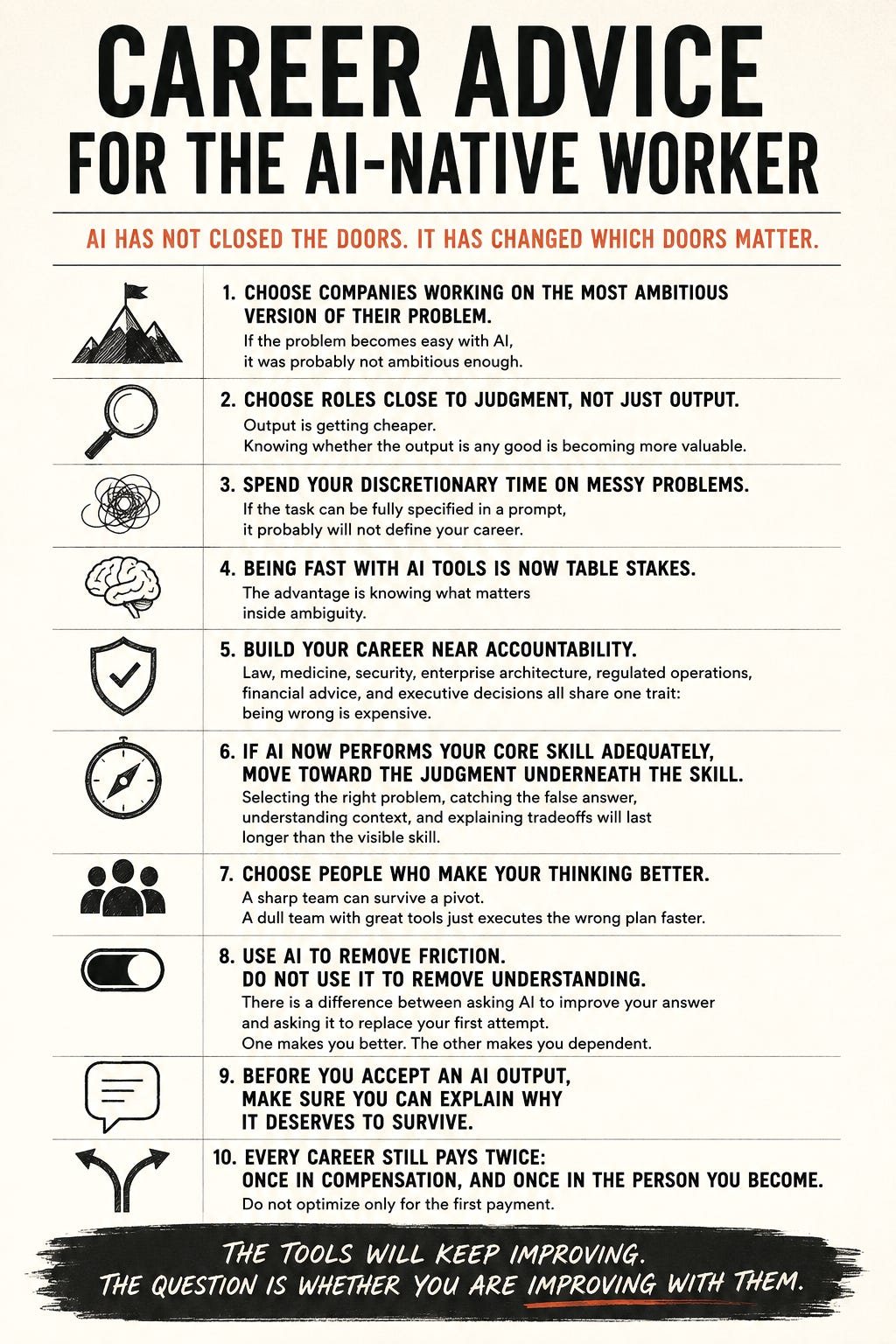
Career Advice for the AI-Native Worker
AI has not closed the doors. It has changed which doors matter.


The advice I’d give today is different from the advice I would have given five years ago.
The world is still full of opportunity. AI has not closed the doors. It has changed which doors matter.
Here is how I would think about choosing a company, a role, a project, a team, or the next few years of your career.
Choosing a company
Evaluate whether the company is working on the most ambitious version of its problem, and whether it actually has a shot at solving it.
A company that has quietly shrunk its ambition to fit what is easy to automate will not teach you much. The best signal is not the mission statement. It is whether the problem would still be hard even with unlimited AI.
Choosing a role
Take the role that puts you close to the parts of the work that still require human judgment.
Roles built entirely around producing output are getting automated fastest, not because the output was worthless, but because output was never the scarce part. The scarce part was knowing whether the output was any good.
Choosing what to work on
AI makes the mediocre version of almost anything cheap.
It does not make the interesting version cheap.
If a task can be fully specified in a prompt, it was probably never going to define your career. Spend your discretionary time on problems still messy enough that nobody has learned how to describe them cleanly yet.
Choosing what to get good at
Being fast with AI tools is now table stakes.
The advantage sits elsewhere: walking into a messy situation, an unclear repo, an ambiguous brief, a broken process, a half-finished analysis, and deciding what actually matters.
That judgment does not come from using AI more. It comes from doing the hard version of the work often enough that the important part starts to stand out.
Choosing where output cannot speak for itself
Durable careers sit near accountability.
Law, medicine, financial advice, high-stakes engineering, enterprise architecture, security, regulated operations, and executive decision-making all share one feature: being wrong is expensive.
In those environments, a polished answer is not enough. Someone has to know where the answer can break.
Build toward that responsibility.
Choosing your five-year bet
If your career was built on skills AI now performs adequately, panic is useless and denial is worse.
Move toward the part of the job that was never really about the skill itself: selecting the right problem, understanding the context, catching the false answer, and explaining the tradeoff.
The visible skill may depreciate.
The judgment underneath it does not.
Choosing who you work with
People and culture matter more in periods of change because the original plan rarely survives.
A sharp team can lose a product and still find the next problem. A dull team with great tools just executes the wrong plan faster.
Choose people who make your thinking better, not just your output faster.
Choosing how to use AI
Use AI to remove friction.
Do not use it to remove understanding.
There is a difference between asking AI to improve your answer and asking it to replace your first attempt. One makes you better. The other makes you dependent.
Before you accept the output, make sure you can explain why it deserves to survive.
Choosing to stay in the game
The path to becoming exceptional has not changed.
Find interesting problems. Work with serious people. Build judgment. Deliver results that hold up under scrutiny.
The tools will keep improving.
That is not the part to worry about.
The question is whether you are improving with them.
Every career still pays twice: once in compensation, and once in the person you become.
Do not optimize only for the first payment.