

The Third Cloud With the First AI Stack
Google owns 14 percent of the cloud infrastructure market. It may already have built the enterprise AI architecture that matters for the next decade.

Google Cloud has spent years in an awkward position: technically admired, commercially third, and packaged with an almost heroic disregard for naming clarity.
That position may finally be changing.
In the first quarter of 2026, AWS held 28 percent of the global cloud infrastructure market, Microsoft held 21 percent, and Google held 14 percent. Google remains considerably smaller than both competitors, despite growing faster and gaining share.
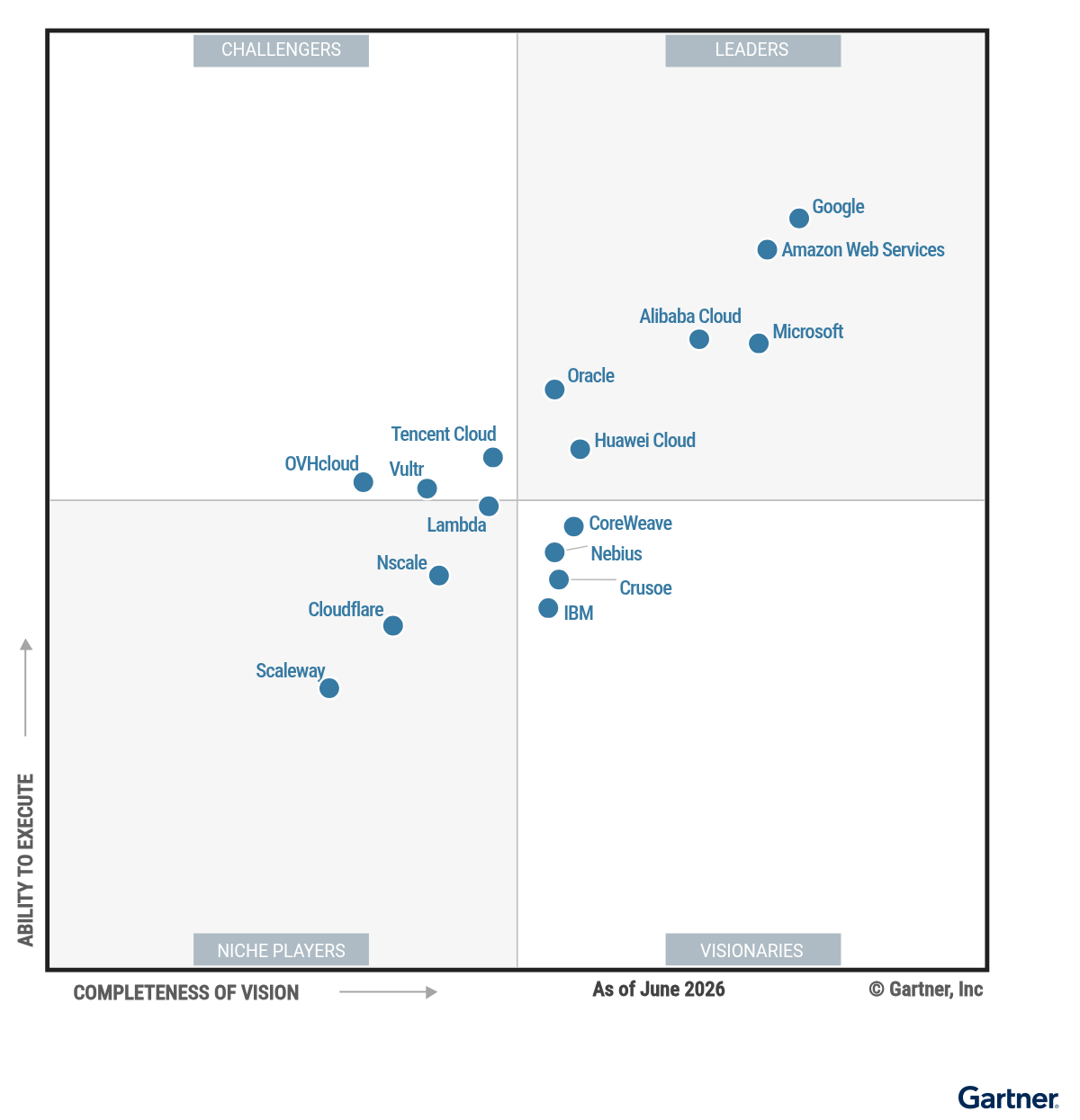
Gartner’s inaugural Magic Quadrant for Cloud AI Infrastructure tells a different story. It places Google highest on ability to execute and furthest on completeness of vision. AWS, Microsoft, Oracle, Alibaba Cloud, and Huawei Cloud also appear in the Leaders quadrant, but Google occupies the strongest position on both axes.
The result deserves attention. It also captures only part of the case for Google.
Gartner evaluated the infrastructure required to train, serve, and operate AI workloads. Its scope includes accelerators, storage, networking, orchestration, security, observability, data pipelines, model platforms, and support for agentic AI. It did not rank foundation models, productivity software, enterprise applications, or overall cloud leadership.
My bullish view rests on the larger system.
Google has assembled the most coherent enterprise AI architecture among the hyperscalers. It controls much of the underlying infrastructure, operates one of the strongest enterprise data platforms, develops frontier models, supports competing models, provides a runtime and governance layer for agents, owns major employee distribution surfaces, and is integrating security across the whole stack.
For years, Google possessed many of these assets without presenting a convincing enterprise system.
That system is now becoming visible.
Gartner Validated the Layer Google Spent a Decade Building
Gartner identifies three major strengths in Google’s infrastructure: proprietary TPUs, the integrated AI Hypercomputer architecture, and the scale of Google’s installed AI compute base.
The report estimates that Google accounted for approximately one-quarter of worldwide cumulative AI compute capacity by the fourth quarter of 2025. Much of that capacity runs on Google’s own TPU silicon rather than third-party GPUs. Gartner also highlights the integration of TPUs and GPUs with Google’s high-performance networking and storage systems.
A large collection of accelerators does not automatically produce an efficient AI system.
Training and inference performance depend on how processors, memory, interconnects, storage, compilers, schedulers, runtimes, and model architectures work together. A bottleneck in any layer can leave extremely expensive hardware waiting for data or moving parameters rather than performing useful computation.
Google has co-designed these layers for more than a decade. Its infrastructure teams and DeepMind researchers built the stack around the demands of Search, YouTube, advertising, recommendation systems, and Gemini. Google Cloud now sells that operating experience to external customers.
Google also says its infrastructure supports nine of the ten leading AI labs and 70 percent of funded AI startups. That is a company-reported claim, but it reinforces the point that the infrastructure is being exercised by demanding external workloads, not only by Google’s internal services.
The feedback loop is strategically valuable. Model research creates new infrastructure requirements. Production traffic exposes reliability and efficiency problems. Hardware constraints influence model architecture. Improvements return to both Google’s internal products and its cloud platform.
Google’s eighth-generation TPUs continue this approach. TPU 8t scales to 9,600 chips and two petabytes of shared memory in a single superpod. Google says it delivers roughly three times the processing power of the previous generation. TPU 8i targets inference, post-training, and memory-intensive agent workloads.
These remain company performance claims, but they show the degree of specialization behind Gartner’s assessment.
The strategic advantage does not depend on every enterprise choosing TPUs.
Google controls an alternative path to AI capacity and economics.
Inference is becoming a large recurring software expense. A provider that depends primarily on another company’s accelerators inherits that supplier’s pricing, allocation decisions, margins, and product cadence. Google can offer NVIDIA hardware where workloads require it while directing suitable demand toward infrastructure designed around its own models, compilers, networks, and serving systems.
That gives Google more control over capacity, performance, and unit economics than a conventional GPU resale business.
Third Place Is Forcing Google to Build for the Real Enterprise
Enterprise technology purchases rarely begin with a clean sheet.
Existing contracts, application estates, identity systems, employee skills, procurement relationships, and data locations shape every major architecture decision. Microsoft can place AI inside an environment already occupied by Microsoft 365, Azure, Windows, GitHub, Entra, Power Platform, and Dynamics. AWS can sell into the world’s largest cloud customer base, backed by mature infrastructure and a service catalog large enough to require its own archaeological discipline.
Google does not enjoy either advantage.
It cannot assume that enterprise data already resides in Google Cloud. It cannot require customers to replace Microsoft identity, AWS infrastructure, Salesforce applications, SAP processes, and decades of internal systems before using Gemini.
Google has to operate across existing estates.
That constraint is shaping some of its strongest products.
The Agentic Data Cloud includes a cross-cloud lakehouse that lets organizations query data in AWS and Azure without copying it into Google Cloud. It uses Apache Iceberg and Google’s cross-cloud networking to give analytics systems and agents access to data across providers. Knowledge Catalog is designed to add business definitions, lineage, permissions, quality information, and semantic context across that estate.
The same pattern appears in the model layer.
Gemini Enterprise Agent Platform provides access to more than 200 models through Model Garden, including Gemini and Gemma alongside third-party models such as Anthropic’s Claude family. Google’s Agent Development Kit and runtime are being positioned as a model-flexible operating environment rather than a closed route to Gemini alone.
This gives Google several ways to participate in the economics of an AI workload.
When Gemini is selected, Google can provide the model, infrastructure, data platform, and runtime. When another model is selected, Google can still provide compute, governed data access, agent execution, identity, observability, evaluation, and security.
The model market will remain fragmented. Different workloads will favor different combinations of reasoning quality, latency, modality, context length, deployment location, risk, and cost. Large enterprises will use several models, often inside the same business process.
Google does not need Gemini to lead every benchmark. It needs the surrounding platform to remain valuable whichever model a customer selects.
That is a more durable commercial position.
Enterprise AI Is Becoming a Context Problem
The first phase of generative AI rewarded model capability. Enterprise deployment increasingly rewards context quality.
An agent cannot reliably approve a claim, reconcile an invoice, alter a supply plan, or advise a customer from model weights alone. It needs current business data, internal definitions, access permissions, process state, policy constraints, and a record of previous actions.
BigQuery already combines warehousing, analytics, machine learning, and access to structured and unstructured data. Google is extending that foundation with cross-cloud access, knowledge cataloging, embedded AI, data agents, semantic context, and lineage.
Alphabet reported that Gemini-powered workflows inside BigQuery grew more than thirtyfold year over year. That figure comes from Google, but it suggests that the data platform is becoming an important route into production AI usage.
Natural-language access to data will become common across platforms. The harder problem lies underneath it.
An enterprise agent needs to know what “revenue,” “customer,” “risk,” or “inventory” means inside a particular company. It needs to know which definition applies, who may see the underlying records, how current the information is, and whether an action based on that information requires approval.
Those semantics and controls cannot be solved by a better chat interface.
They require a governed context layer.
Google’s history in search becomes commercially relevant here. The company has spent decades retrieving, ranking, and contextualizing information. Enterprise environments add identity, permissions, lineage, proprietary semantics, and regulation. The retrieval problem remains familiar, while the control requirements become much stricter.
This gives Google a credible path to become the intelligence layer across a company’s data estate without first becoming the exclusive home of that estate.
That opportunity is larger than another warehouse migration.
Google Is Treating Agents as Enterprise Infrastructure
Many enterprise agent products still resemble sophisticated demonstrations surrounded by an enthusiastic PowerPoint.
The model can reason. The agent can call tools. The prototype completes a carefully selected workflow.
Then the security team asks who authorized the action, the risk team asks how it can be audited, and the platform team asks how many other agents are operating without anyone knowing.
Production begins where the demonstration ends.
Gemini Enterprise Agent Platform addresses this operating layer directly. Agent Identity assigns a managed identity to each agent. Agent Registry inventories agents, tools, and skills. Agent Gateway governs connections between agents, data, and tools. Agent Runtime supports long-running, stateful execution, while Memory Bank retains persistent context. Simulation, evaluation, observability, and execution traces provide controls for testing and production operations.
These sound like administrative features. They will determine whether companies can deploy agents at scale.
Once an agent can access applications and take actions, it becomes a new class of enterprise actor.
It needs permissions, credentials, boundaries, monitoring, revocation, and accountability. A company operating hundreds or thousands of agents cannot govern them through spreadsheets, informal review boards, and good intentions.
Google is turning those requirements into platform services.
This moves the competitive discussion beyond model quality. Enterprises will also evaluate whether a platform can answer basic operational questions:
Which agents exist?
Who owns them?
What data can they access?
Which tools can they invoke?
What actions did they take?
Which model produced a decision?
What policy approved it?
How can access be revoked?
The platform that answers those questions consistently will have an advantage in regulated and operationally complex environments.
Security Now Has a Coherent Place in the Stack
Google’s security portfolio once looked like a collection of respected assets with an uncertain commercial center.
Agentic AI gives those assets a common purpose.
Google completed its acquisition of Wiz in March 2026, adding multicloud security posture, workload visibility, and AI application protection to existing capabilities from Mandiant, Google Threat Intelligence, Security Operations, and Model Armor. Google is integrating Model Armor with Agent Gateway and Agent Runtime, while Agent Identity provides agents with distinct credentials and scoped permissions.
The architecture fits the risk.
Agents create machine-speed access and action. Security controls have to inspect identity, prompts, model responses, data access, tool calls, and downstream actions at comparable speed.
This is also where Google’s multicloud position helps. Wiz was built to provide visibility across cloud providers. Large companies will not operate agents inside one clean vendor boundary. Their agents will cross Google Cloud, AWS, Azure, SaaS applications, internal APIs, browsers, and private infrastructure.
A security platform that assumes a homogeneous estate will have a limited view of the problem.
Google can combine its own AI runtime controls with Wiz’s broader cloud visibility and Mandiant’s threat intelligence. The integration is still developing, but the pieces fit together unusually well.
The Application Layer Is Finally Connected
Google has long possessed strong research and infrastructure. Its recurring enterprise weakness has been packaging and distribution.
The packaging problem has not entirely disappeared.
Gemini is a model family, an employee application, and part of the name of a development platform. Vertex AI is becoming Gemini Enterprise Agent Platform. Gemini Enterprise also refers to the environment through which employees discover and use agents.
Somewhere in Mountain View, a product-naming meeting has clearly achieved long-running agent status.
Behind the terminology, the architecture is becoming coherent.
Developers build and govern agents through Gemini Enterprise Agent Platform. Employees access them through the Gemini Enterprise application. Those agents can draw context from BigQuery and Knowledge Catalog, call external systems, operate across Workspace, and connect with products from vendors such as Salesforce, SAP, ServiceNow, Workday, Atlassian, and Oracle.
Workspace provides distribution across email, documents, spreadsheets, meetings, and collaboration. Chrome offers another route into daily employee activity. Android extends that reach to mobile devices. Google Cloud provides the runtime and data platform beneath them.
Microsoft retains the stronger enterprise application franchise. Google does not need to recreate it product by product.
Agents can operate across applications while Gemini Enterprise becomes the place where employees commission, supervise, and approve the work.
That is a more credible distribution strategy than attempting to displace every incumbent productivity and business application.
Enterprise AI Needs Implementation Capacity
Enterprise AI does not scale through products alone.
Companies need help redesigning workflows, preparing data, integrating applications, governing access, changing operating models, training employees, and measuring economic results. The required work sits across architecture, process design, cybersecurity, data engineering, and organizational change.
Google is investing heavily in the partner layer.
At Cloud Next 2026, it announced a $750 million fund for agent development and deployment, deeper programs with major systems integrators, and Google forward-deployed engineers working alongside consulting partners. Google says its global consulting and integration partners now include more than 330,000 professionals trained on Google AI.
Alphabet also reported ninefold year-over-year growth in Gemini Enterprise seats sold with partners and a ninefold increase in partners using the product internally. Paid monthly active users grew 40 percent quarter over quarter.
These remain company-reported measures, but they show increasing distribution through channels that matter to large enterprises.
The broader commercial numbers reinforce the point.
Google Cloud revenue grew 63 percent in the first quarter of 2026, exceeding $20 billion for the first time. Backlog rose to more than $460 billion. Alphabet said enterprise AI products had become the primary growth driver for Cloud.
Those figures do not prove that Google has secured long-term leadership. They do show that the architecture is producing material demand.
The Risks Become Operating Problems for CIOs and CFOs
Google’s position is strong, but adoption will create difficult decisions.
Gartner flags cost complexity across model usage, Gemini Enterprise services, TPUs, GPUs, storage, data processing, and infrastructure commitments. A single agent workflow may consume tokens, runtime compute, memory, network capacity, database queries, security services, and third-party tools.
That complexity turns directly into planning problems for CIOs and CFOs.
Enterprises will need workload-level unit economics, usage controls, chargeback mechanisms, capacity planning, and clear accountability for retries, failed actions, human review, and downstream defects. A low token price can still produce an expensive business process.
TPUs create another architectural decision. Open framework support is improving, but teams that optimize deeply for Google’s hardware may adopt tooling and runtime patterns that increase migration effort later.
CIOs will need to decide where TPU-specific optimization produces enough economic value to justify lower portability, and where standardized deployment remains more important.
Google also faces availability constraints for some high-demand NVIDIA resources. Custom silicon reduces its dependence on NVIDIA without eliminating it.
The commercial challenge may prove harder than the technical one. Google must simplify procurement, explain packaging, improve cost transparency, and help customers operate the platform without assembling a small army of specialists.
Microsoft will continue to exploit its application and identity footprint. AWS will continue to exploit its infrastructure scale, custom silicon, customer relationships, and operational maturity.
Both competitors have the capital, installed base, and engineering depth to close architectural gaps.
Why I Am Bullish
Google’s weaknesses are increasingly execution problems.
Its strengths are structural.
The infrastructure is designed alongside the models. The data platform supplies governed business context. The agent platform manages execution, memory, identity, and policy. The model layer supports Gemini, open models, and competitors. The security portfolio extends across multicloud estates. Workspace and Gemini Enterprise bring the system to employees. Partners provide the implementation capacity required to redesign real work.
Google’s third-place cloud position has also imposed useful discipline. It cannot assume that it owns the customer’s infrastructure, identity, data, or applications. It has to work across the existing estate.
That pressure has pushed Google toward cross-cloud data access, open formats, multi-model choice, external integrations, and governed interoperability.
Google Cloud does not need to overtake AWS in total infrastructure market share before becoming central to enterprise AI. It can capture high-value AI workloads, agent execution, governed data interactions, model usage, and security while much of the underlying application estate remains elsewhere.
Gartner’s report validates the foundation.
The larger case lies in what Google is connecting above it.
Google is still the third cloud.
It may already have the first complete enterprise AI stack.
References:
Magic Quadrant for Cloud AI Infrastructure https://www.gartner.com/en/documents/8084665