
Meta’s Consent Machine
Public photos, private faces, and the oldest trick in Meta’s playbook

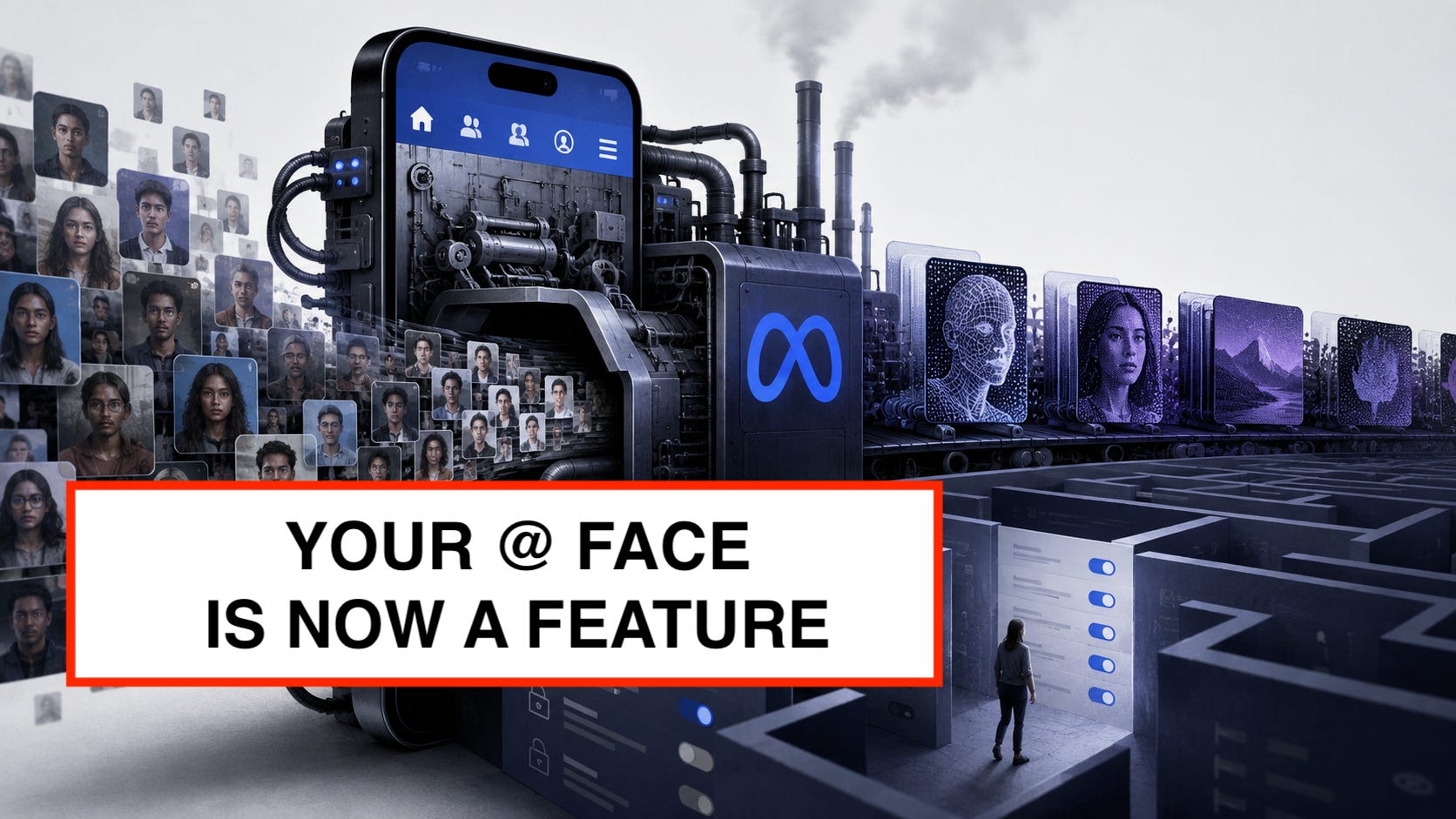
Meta’s Muse Image mess is not a product accident.
It is a design pattern.
The company launched Muse Image, its first image-generation model from Meta Superintelligence Labs, with deep hooks into Instagram, WhatsApp, Meta AI, and eventually Advantage+ creative for advertisers. The useful-sounding feature is simple: tag a public Instagram account in a prompt, and Meta AI can use that account’s public photos to generate an image.
The disturbing part is also simple.
Public Instagram accounts are opted in by default.
No affirmative consent. No direct warning before your face becomes prompt material. No notification when someone uses your public profile in a generation. No clean undo button after the output exists.
Just another setting, waiting quietly in the machinery.
The Privacy Problem Is the Product Design
The control lives inside Instagram settings under “Sharing and reuse.” To stop people from using your posts and reels with Meta’s AI features, you have to find the right submenu and switch off separate toggles for posts and reels. Wired reported that changing the setting blocks future use, but already generated AI images are not deleted.
That sentence should make every product leader uncomfortable.
Future use can be restricted.
Past damage remains.
Meta has built a consent model where participation is automatic, protection is manual, and reversibility ends exactly where user harm begins. This is not how a serious privacy architecture behaves. This is how a growth system behaves when privacy is treated as a UX inconvenience.
The company knows how defaults work. It has spent two decades studying clicks, scrolls, hesitation, attention, decay, impulse, fatigue, and every tiny behavioral leak that can be converted into advertising yield.
So when a company with that much behavioral sophistication hides a meaningful privacy control behind vague language and multiple steps, it does not get to plead innocence.
It designed the funnel.
This Started Before Muse
In 2023, Meta released Imagine with Meta AI, powered by its Emu image model. That model was trained on 1.1 billion publicly visible Facebook and Instagram images, according to coverage of Meta’s own research and disclosures.
The language then was careful. Publicly visible. Available content. Training data.
Technically neat. Morally evasive.
A birthday party photo posted for friends, followers, cousins, classmates, and neighbors does not magically become an invitation to train an image model. “Public” on a social network has always meant socially visible. Meta keeps treating it as industrially extractable.
That distinction is the whole fight.
People did not join Instagram to become latent-space mulch for the next advertiser workflow. They posted vacations, graduations, pets, meals, bad haircuts, gym selfies, and awkward conference photos because social media trained them to confuse visibility with safety.
Meta has now converted that confusion into model fuel.
The Business Logic Is Not Hidden
Muse Image is not just a consumer toy. Meta says it will power creative experiences across its apps and is coming to advertisers through Advantage+ creative. Reuters also reported that additional creation capabilities will sit behind Meta’s subscription plans.
That matters.
The privacy issue is not floating separately from the business model. It sits inside it.
Meta owns a social graph, a photo archive, a creator ecosystem, a messaging surface, an ad engine, and a distribution machine. Muse Image ties those assets together. Your likeness becomes a creative input. Your social context becomes prompt context. Your archive becomes product surface. Your discomfort becomes a settings problem.
This is the old Meta bargain, translated into generative AI.
You supply the raw material.
Meta supplies the cheerful interface.
Advertisers get the operating leverage.
The Old Scandals Were the Warning Label
This is the same company whose researchers ran a massive emotional-contagion experiment on 689,003 Facebook users by altering the emotional content of News Feeds.
It is the same company connected to the Cambridge Analytica scandal, where the FTC found that a political consulting firm used deceptive practices to harvest personal information from tens of millions of Facebook users for voter profiling and targeting.
It is the same company Amnesty International accused of contributing to real-world violence in Myanmar through algorithmic amplification of anti-Rohingya content.
It is the same company exposed by Frances Haugen’s disclosures, which showed internal research and complaints about the gap between Facebook’s public statements and its private knowledge of platform harms.
Muse Image is not identical to those scandals. The mechanism is different.
The governance failure is familiar.
Again and again, Meta ships systems that convert human behavior into machine advantage, then asks users, regulators, and civil society to clean up the consequences after launch.
The Real Issue Is Not AI Art
The easy version of this debate will get trapped in shallow arguments about whether public photos are fair game, whether AI images count as parody, whether creators should expect reuse, whether users should just make their accounts private.
That is the wrong debate.
The serious issue is whether platforms can keep expanding the meaning of “use” after the fact.
A user uploaded a photo to participate in a social network. Meta later decided that photo could train models, personalize AI outputs, feed creative tools, and support advertising infrastructure. The permission boundary moved after the data was collected.
That is not consent.
That is retrospective monetization.
AI makes this worse because the output layer changes the harm. A photo used for ad targeting is creepy. A photo used to generate synthetic images of a real person is more intimate, more volatile, and harder to contain. The old privacy model already struggled with inference. It is not built for likeness generation at platform scale.
The Cost Never Lands Where It Should
Meta paid a $5 billion FTC penalty in 2019 for privacy violations, then kept growing. In Q1 2026, Meta reported $56.3 billion in quarterly revenue, including $55.0 billion in advertising revenue.
That is the arithmetic behind the behavior.
Fines arrive as events. Ad revenue arrives as a system.
Unless the system changes, the product logic keeps winning.
That is why Muse Image matters. Not because it is the worst thing Meta has ever done. It probably is not. That is a depressing sentence to write, but accuracy has its burdens.
Muse Image matters because it shows how quickly the old social-media privacy bargain is being rewritten for the AI era. Public posts become training data. Public profiles become prompt handles. Personal archives become generation material. The opt-out sits in settings. The burden sits with the user.
The company calls this creativity.
A better word is extraction.
And Meta remains very, very good at it.