

The Cloud Commitment Is Becoming the AI Strategy
Google’s latest results show how enterprise AI adoption can harden into architecture before anyone has proved the economics of the workflows underneath it.

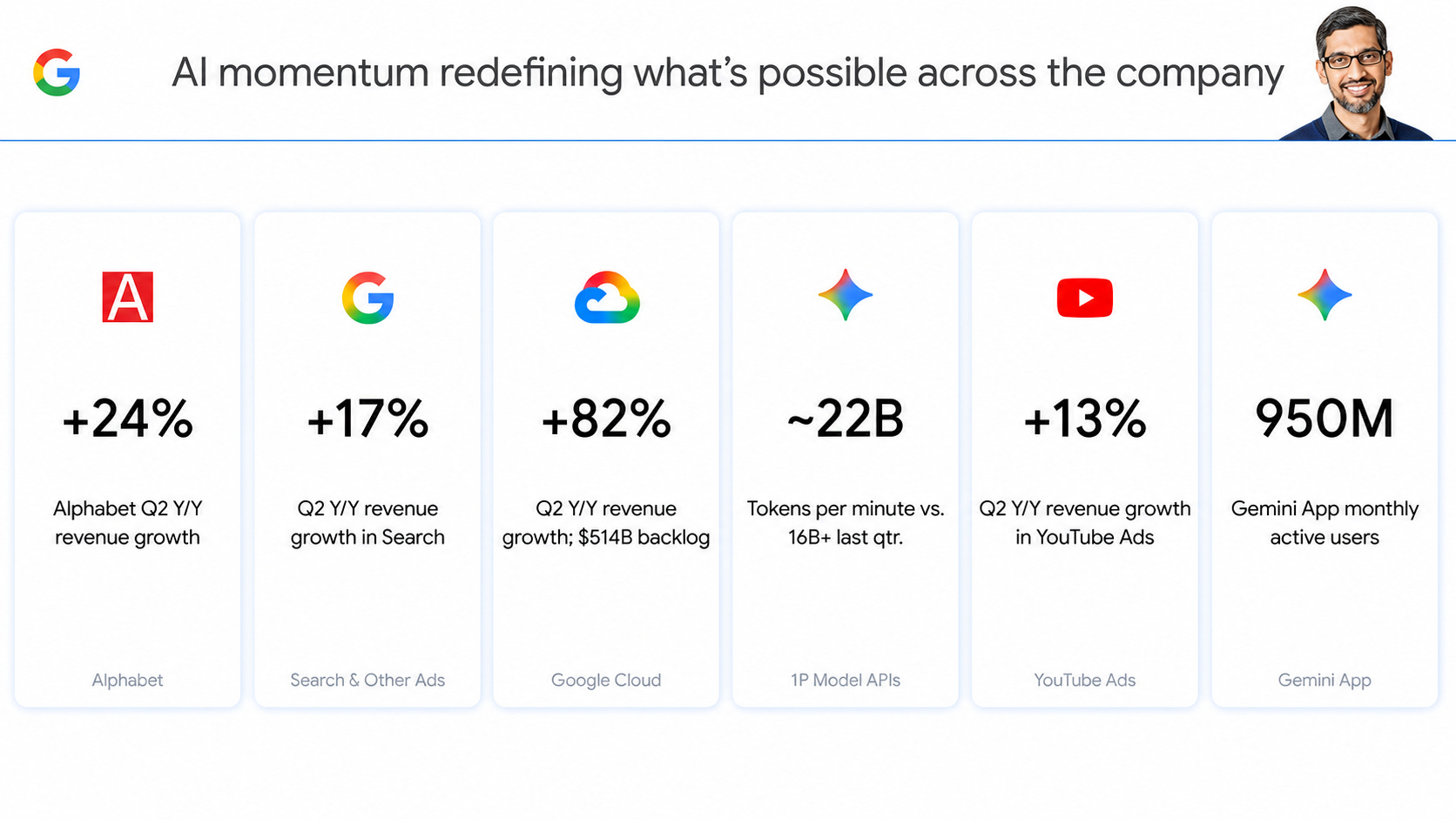
Google Cloud grew 82 percent in the second quarter. For enterprise buyers, the more revealing number may be 50 percent.
Google said customers expanding their use of Cloud were exceeding their commitments by more than 50 percent. Cloud backlog reached $514 billion. Marketplace transactions increased more than sevenfold. Nearly 500 customers processed more than one trillion tokens during the past year, while more than 2,000 enterprises crossed 100 billion tokens.
The numbers confirm strong demand. They also show how the commercial structure around cloud purchasing is beginning to shape enterprise AI architecture.
Cloud commitments were designed for workloads that could be forecast with some confidence. A company estimated its future infrastructure consumption, agreed to a minimum spend, and received better pricing in return. Procurement negotiated the terms. FinOps tracked utilization. Architecture teams continued making workload decisions within the agreement.
AI makes that separation harder to maintain.
A production AI system may consume models, accelerators, databases, vector storage, networking, security services, agent runtimes, observability, evaluation infrastructure and third-party software. Google can provide almost every layer. It also operates a marketplace where customers can apply committed spend to products from other vendors.
Once these services draw from the same commercial agreement, the commitment stops functioning only as a discount. It starts financing the enterprise AI platform.
That is the decision buried inside Google’s quarter.
Demand is visible. Customer economics are not.
Google reported $24.8 billion in Cloud revenue, up from $13.6 billion a year earlier. Cloud operating income rose from $2.8 billion to $8.8 billion.
The growth is substantial, but the headline requires care. Alphabet now includes product revenue generated primarily from TPU system sales within Google Cloud. The reported increase therefore combines cloud services and hardware. The company does not disclose how much came from infrastructure consumption, Gemini Enterprise, Workspace, security, Marketplace products or TPU purchases.
Its adoption metrics have similar limits. Nearly 90 percent of the Fortune 100 may use Gemini Enterprise, but “use” can mean a limited deployment, a paid trial or a strategic production platform. Token volume proves activity. It does not show whether that activity reduced the cost of a business process, improved quality, removed labor, increased revenue or merely created another technology bill.
Google is reporting the information investors need to assess its business. Enterprise buyers need a different set of numbers.
A large backlog validates demand for Google. It does not validate the business case of every customer contributing to it.
A cloud commitment allocates risk
A commitment is usually described as a way to secure lower prices. It is also a transfer of forecasting risk.
The provider receives greater revenue certainty and can invest against expected demand. The customer receives a discount and, in some cases, better access to capacity. In return, the customer accepts the possibility that actual consumption will differ from the original forecast.
That exchange is manageable when workloads are mature. Enterprises have years of history for compute, storage and database consumption. Forecasts remain imperfect, but the units are understood.
AI demand has fewer stable boundaries.
An assistant that gains adoption attracts more users and longer sessions. A larger model may use more tokens. An agent may call several models, query multiple systems, invoke tools, retry failed actions, run evaluations and store traces. One visible employee request may trigger dozens of billable operations across the stack.
The provider sees consumption growth. The buyer may still be trying to establish what the workflow costs.
This produces an awkward incentive. Underuse makes the commitment look poorly negotiated. Rapid consumption looks like adoption. Neither tells leadership whether the company is buying useful work.
Google’s disclosure that expanding customers exceed commitments by more than 50 percent is a strong commercial result. It should also cause CIOs and CFOs to ask what, precisely, is exceeding the forecast.
The agreement can choose the stack
Google’s advantage no longer rests on a single model or cloud service.
It can supply the accelerator, network, storage, data platform, models, development environment, agent runtime, security layer, employee work surface and purchasing channel. Each product can be evaluated independently. Together, they exert pressure toward concentration.
The sequence is easy to imagine because parts of it are already common.
A development team begins with Gemini APIs. It connects the application to data in BigQuery. Security adopts Google controls because they integrate with the existing environment. Developers use the agent platform because the models, data and deployment services are already there. The company rolls out Gemini Enterprise or Workspace features to employees. Business units begin buying specialized software through Cloud Marketplace. Finance encourages those purchases because they help consume the existing commitment.
No executive committee needs to declare Google the standard enterprise AI platform. The standard can emerge through a series of locally sensible decisions.
By the next renewal, moving a workload may require far more than changing a model endpoint. The enterprise may need to recreate memory, evaluations, identity mappings, security policies, agent definitions, traces, data access patterns and operating procedures.
The commitment did not merely reduce the price of the architecture. It helped create the architecture.
The issue is not whether cloud commitments are desirable. They can provide real savings, capacity access and commercial simplicity. Nor is concentration inherently poor architecture. A coherent platform can reduce integration cost and operating complexity.
The issue is whether leadership intends to make that concentration decision or discovers later that the commercial agreement made it on the company’s behalf.
CIOs and CFOs should therefore treat material AI commitments as architecture and operating-model decisions, not routine cloud renewals. Before increasing the commitment, they need evidence of workflow economics, visibility into the dependencies being created, and a clear position on where provider concentration is acceptable.
Below the paywall, I examine why agentic workloads make conventional consumption forecasts unreliable, how Marketplace purchasing can distort product selection, the legitimate case for concentrating on one provider, and what leadership should require before the next cloud agreement becomes the enterprise AI strategy.
