

The Data Center That Bleeds
Silicon powered the first era of AI infrastructure. Biology may power the next.

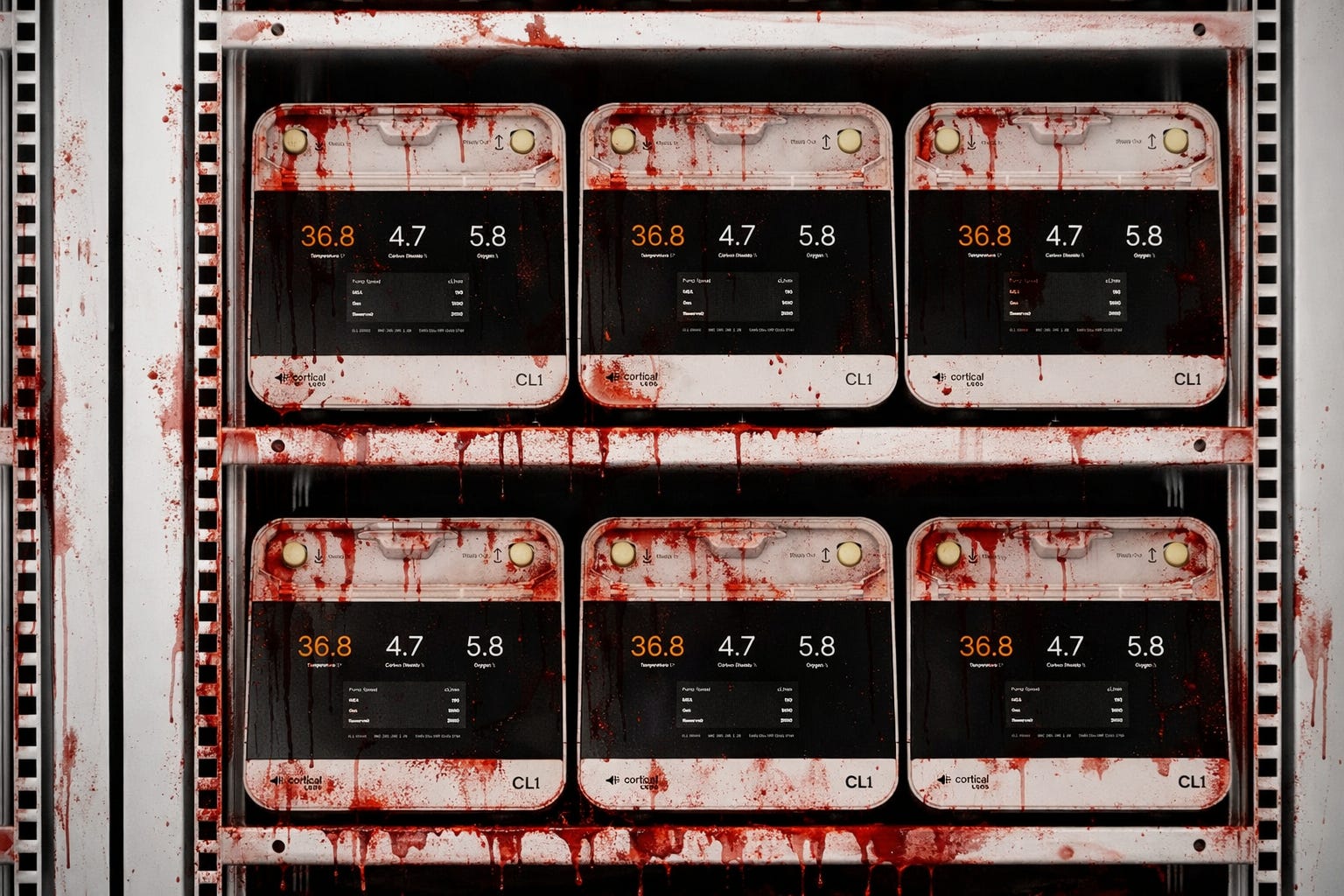
There is a building in Melbourne where the servers are alive.
Not metaphorically alive. Actually alive.
Inside racks that look like ordinary lab equipment sit clusters of human neurons grown from stem cells taken from blood. The cells float in a nutrient solution on top of micro-electrode arrays that send electrical signals in and read signals out. Those signals become computation.
Instead of transistors switching on silicon, it is neurons firing.
Cortical Labs opened this facility quietly. Another site is already planned for Singapore. Much of the tech industry has filed the story under curiosity or neuroscience.
That framing misses the real issue.
This is infrastructure.
And it appears at the exact moment the current AI infrastructure model is running into physics.
The Energy Wall
Large AI data centers now operate at a scale the electricity grid never anticipated.
New hyperscale facilities regularly exceed one gigawatt of continuous draw. That is roughly the power consumption of a mid-sized city. And the load does not fluctuate much. Training clusters and inference fleets run around the clock.
Electricity markets near data center clusters have started to show the strain. Wholesale prices have surged in regions where hyperscale construction is concentrated. Utilities are racing to add generation capacity. Regulators are suddenly discussing whether new facilities should even be approved.
AI is the primary reason.
Transformer models reward scale. Larger models, larger training runs, larger inference fleets. Every improvement in capability requires more compute and therefore more power. Efficiency gains in chips and cooling slow the growth curve but do not change its direction.
The architecture itself demands scale.
Which is why Cortical Labs’ claim about its CL1 system matters.
Each unit consumes less power than a handheld calculator.
That statement is not a novelty. It points directly at the constraint that now defines AI infrastructure.
What the CL1 Actually Is
The CL1 is a commercial device priced around $35,000.
Each unit contains about 800,000 human neurons grown from induced pluripotent stem cells. The cells are arranged on a micro-electrode array that both stimulates them and reads their responses.
The entire system sits inside a sealed life-support environment that controls nutrients, temperature, and gas exchange. Once installed, it operates autonomously for months.
Software interacts with the neurons through electrical signaling. Inputs arrive as patterns of stimulation. Outputs appear as patterns of neural activity.
The company refers to this approach as Synthetic Biological Intelligence.
The neurons are not simulating learning. They are learning through the same electrochemical feedback processes that govern biological neural networks.
When the network produces undesirable behavior, it receives disruptive stimulation. When the behavior improves, the disturbance stops.
The cells adapt.
