

When Robots Meet Reality
Physical AI is becoming a deployment challenge, not an intelligence challenge.

Gravity, Governance, and Robots
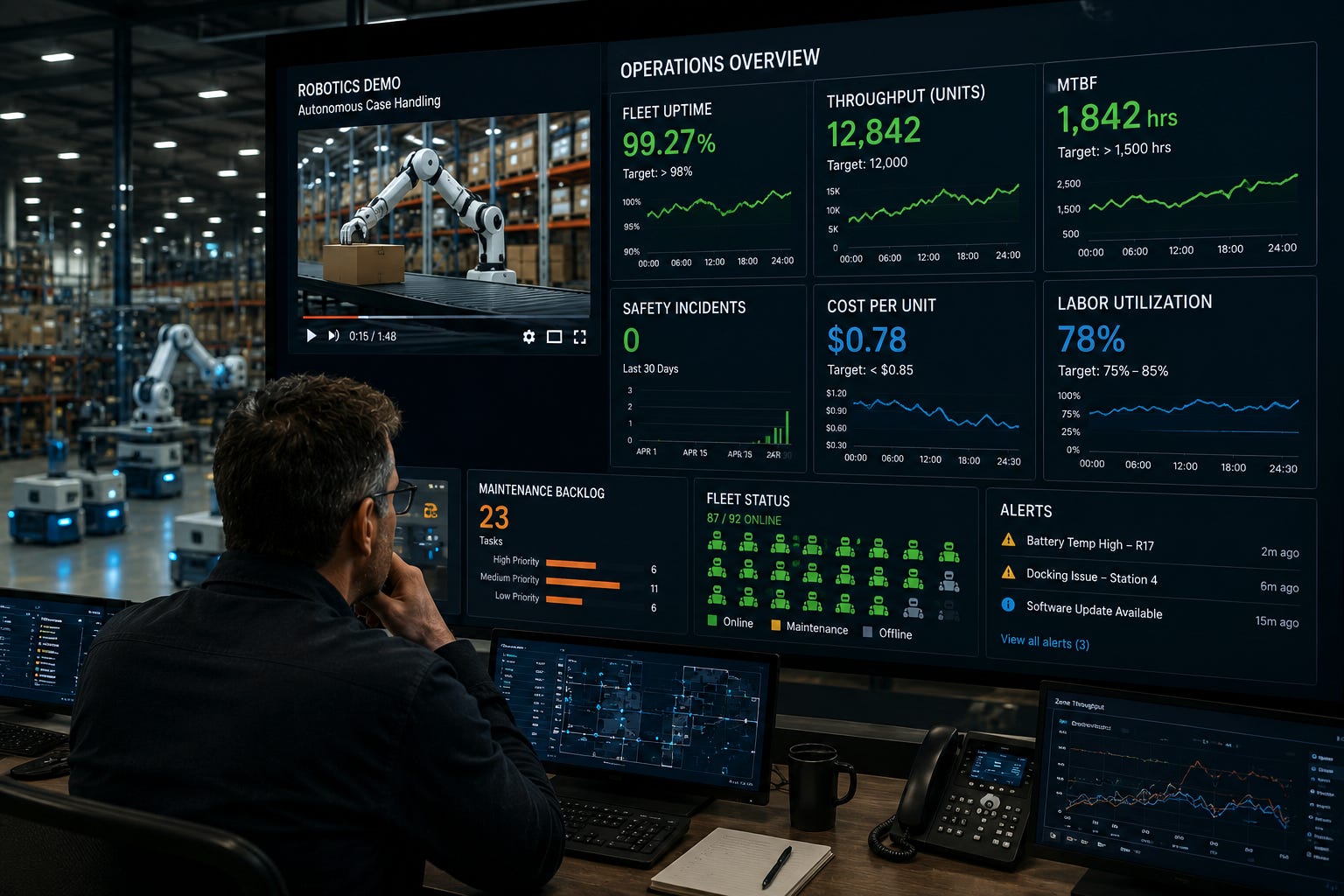
The physical AI market is developing a familiar habit. Most discussions focus on intelligence. Can the robot understand instructions? Can it generalize to unfamiliar environments? Can it reason about objects, space, motion, and intent? Every product announcement, benchmark, and demo seems designed to answer some variation of those questions.
They are important questions, but they are not the ones that determine whether a technology becomes infrastructure.
The history of enterprise technology is littered with examples of systems that demonstrated impressive technical capability and generated disappointing economic returns. The lesson from enterprise AI over the past three years was not that models lacked intelligence. In many cases, the models performed remarkably well. The problem was that intelligence turned out to be only one component of a much larger system involving governance, integration, workflow redesign, incentives, operating procedures, and accountability.
Physical AI is heading toward a similar realization, except the economics are considerably less forgiving.
A chatbot that produces an incorrect answer creates inconvenience. A robot that makes an incorrect decision can halt a production line, damage inventory, create a safety incident, or force an expensive operational shutdown. In software, occasional failure is often tolerated. In operations, failure accumulates costs very quickly.
That distinction changes the conversation.
Much of the current excitement around physical AI assumes that intelligence is the primary bottleneck. The underlying belief is straightforward: once machines become sufficiently capable of understanding and navigating the physical world, widespread adoption will follow naturally. The assumption sounds reasonable until you look at how operational systems actually succeed.
Factories, logistics networks, airlines, power grids, and telecommunications systems do not compete primarily on capability. They compete on consistency. The question is rarely whether a system can perform a task. The question is whether it can perform the task reliably, predictably, and economically thousands or millions of times over extended periods of time.
Aviation offers a useful comparison. The value of a commercial aircraft is not that it can fly. Humans solved that problem more than a century ago. The value comes from the ability to fly safely, repeatedly, and profitably while operating inside an extraordinarily complex ecosystem of maintenance procedures, training programs, spare parts inventories, regulatory requirements, operational controls, and service networks. The aircraft itself is only one component of the system.
Physical AI is approaching a similar inflection point. Today’s demonstrations focus on what the machine can do. Tomorrow’s buyers will focus on how the system behaves over time.
That shift has important implications for where value is likely to accumulate.
The current conversation often treats the robot as the product. In practice, the robot may become the least differentiated part of the offering. The harder challenge is creating the infrastructure around the robot. Organizations deploying physical AI will need fleet management capabilities, software update mechanisms, remote monitoring systems, safety controls, incident response processes, maintenance operations, testing frameworks, simulation environments, audit trails, and clear accountability models. These are not glamorous problems, but they are the problems that determine whether a deployment succeeds.
This is one reason I remain skeptical of the industry’s fixation on humanoid robots.
Humanoids make for compelling demonstrations because they align naturally with human intuition. We understand what they are attempting to accomplish. Investors can easily imagine the market opportunity. Journalists can explain the story. The visual narrative is powerful.
Yet businesses rarely purchase technology because it tells a compelling story. They purchase technology because it improves economics.
A warehouse operator is not searching for a humanoid robot. They are searching for greater throughput, lower costs, reduced labor constraints, and more predictable operations. If a humanoid robot achieves those objectives, it will find a market. If a robotic arm, an autonomous mobile robot, or a redesigned workflow delivers the same outcome more effectively, the market will move in that direction instead.
Technology history repeatedly demonstrates that elegant solutions do not necessarily win. Economically efficient solutions do.
That observation leads to a broader point about how physical AI may evolve. The industry’s center of gravity could shift away from intelligence and toward deployment economics. As the underlying models improve, differentiation may increasingly come from service networks, maintenance capabilities, operational tooling, integration frameworks, safety certifications, and deployment expertise.
This would not be unusual. Mature technology markets often create more value in implementation than invention.
Enterprise software followed this pattern. Cloud computing followed this pattern. Cybersecurity followed this pattern. In each case, the market initially focused on technical capability before eventually recognizing that operational execution was where most value was created.
Physical AI appears to be following a similar trajectory.
There is another reason enterprise leaders should pay close attention. Physical AI represents one of the first major technology categories that genuinely forces the convergence of information technology and operational technology. For decades, those domains have remained largely separate. Information systems managed data, transactions, and business processes. Operational systems managed machines, facilities, and physical processes.
Physical AI sits directly at the intersection of those worlds.
A robot may consume information from planning systems, inventory systems, scheduling systems, digital twins, and AI models before translating those inputs into physical action. Once software gains the ability to influence physical operations at scale, traditional boundaries between IT and operations begin to disappear. Governance models change. Security models change. Risk models change. The operating model itself changes.
That organizational shift may ultimately prove more important than the robotics itself.
The deeper lesson from enterprise AI was that production systems matter more than prototypes. Intelligence captured the headlines, but integration, governance, and operating discipline determined outcomes. Physical AI is unlikely to be different. The companies that create enduring value may not be the ones with the most impressive demonstrations. They may be the organizations that learn how to operate intelligent machines reliably inside complex environments.
That sounds less exciting than a robot folding laundry or serving coffee.
It is also where markets are usually won.
The future of physical AI will certainly involve better models, richer simulation environments, and more capable machines. Yet the decisive factor may be far more mundane. The winners will likely be determined by who can transform intelligence into dependable infrastructure.
History suggests that infrastructure is where technology stops being interesting and starts becoming indispensable.